Wednesday, October 2, 2013

Intelligent personal assistant app Cue, formerly known as Greplin, shuts down


Cue, the intelligent personal assistant app that began its life as Greplin, has announced on its homepage that it has shut down. All of the app’s data and your personal information has not be stored or transferred; Cue says it has already been permanently deleted in accordance with the company’s privacy policy.


Premium users who registered through the website will be getting a prorated refund while Premium users who registered though the iPhone app can request one through iTunes. Cue gave an apology but the announcement seems to have come completely out of the blue: there was no warning, no shut down date, and no explantion beyond “the Cue service is no longer available.”


Before the intelligent personal assistant app, there was Greplin, which the company described as a “personal search engine that allows you to search all your online data in one easy place.” It let you sift through emails, tweets, and Facebook status updates from the Greplin site or the Greplin app for iOS.


In June 2012, the company rebranded as Cue, also available as both a website and iOS app. Cue pulled information from all your online accounts to present an overview of your upcoming day, in addition to the social search function provided by Greplin.


Here’s the announcement, which we’re including in full as it’s not clear how long the website will be up for:


We appreciate all of the support from you, our users, as Cue has grown over the last few years. However, the Cue service is no longer available.


Cue Premium users who registered through the website will receive a prorated refund. Cue Premium users registered though the iPhone App can request a refund through iTunes. In accordance with our privacy policy, your data and personal information will not be stored or transferred; it has been permanently deleted.


We apologize for any inconvenience this might cause you. It’s been an incredible journey that wouldn’t have been possible without your loyal support.


Our sincerest thanks,

- The Cue Team


Cue was founded by Daniel Gross and Robby Walker. Their curt message doesn’t explain where they’ll be heading next, but they’re definitely worth watching out for.


See also – Greplin Founder Daniel Gross on his amazing story behind building the company [Interview]


Top Image Credit: Alan Bridges


via http://feedproxy.google.com/~r/TheNextWeb/~3/NOnIVcCaLqs/

Yahoo reveals a new vulnerability reporting policy with rewards of up to $15,000


Yahoo revealed today that it will dole out rewards of up to $15,000 (and starting from $150) to individuals and firms that inform the company of bugs and vulnerabilities classified as new, unique and/or high-risk issues, as part of an updated vulnerability reporting policy.


This is a huge change from what Yahoo has been giving to researchers who have discovered bugs and reported them to the company: a t-shirt. Just a few days ago, Graham Cluley reported that researchers at High-Tech Bridge were rewarded with a $12.50 voucher to buy a corporate t-shirt.


Although the finalized policy will only kick in by October 31, the company is implementing the benefits retroactively back to July 1, 2013.


As it scrambles to brush up its image, Yahoo Paranoids director Ramses Martinez says in a blog post: “If you submitted something to us and we responded with an acknowledgement (and probably a t-shirt) after July 1st, we will reconnect with you about this new program. This includes, of course, a check for the researchers at High-Tech Bridge who didn’t like my t-shirt.”


Martinez adds that the company is improving its reporting process for vulnerabilities, with a new site that will make it easier to inform Yahoo of issues, which will in turn help to improve its overall speed and quality. He says that people who report issues that get validated by Yahoo’s team will be contacted directly in no more than 14 days after submission.


Headline image via Justin Sullivan/Getty Images


via http://feedproxy.google.com/~r/TheNextWeb/~3/AgpOMzsQFCU/

The Scientific Method: Tech studio Science Inc.’s plan to build startups with repeatable results


LA-based technology studio Science Inc. recently moved to a new office in Santa Monica, so we stopped by to chat with co-founders Mike Jones and Peter Pham about how the operation is going.


In just two years, Science has built up a significant portfolio of rapidly growing companies like Dollar Shave Club and Dog Vacay. However, the studio’s strategy has changed since it first began.


“We’ve evolved a lot. We originally thought we were going to spin everything out,” Jones said.


But, as the startups Science built became profitable, the team realized that it was better off just keeping them in-house. The organization grew into a central hub of highly-specialized experts that could quickly turn ideas into businesses.


“The more we invested in Science’s core infrastructure, the better our entire portfolio got.”


Science has three main approaches: it builds its own companies, takes small positions in companies that it can advise and help grow, and it acquires startups to bring them in-house.


According to Jones, the studio has benefitted from keeping a narrow focus on consumer products in three specific categories: online brands, shared economy marketplaces and infrastructure-oriented ad technologies and platforms.


Science got its start with a $10 million round in 2011. Earlier this year, it took on $30 million from Hearst Ventures. In addition to Science’s own fund, Pham noted that the studio’s portfolio companies have raised almost $70 million from outside investors.


The firm’s companies have had their share of struggles, too. Kids clothing subscription box startup Wittlebee had some fundraising trouble earlier this year that led CEO Sean Percival to step down.


Jones and Pham don’t describe their operation as an incubator, venture firm or an accelerator, calling it a technology studio instead.


“The word hands-on has a whole new meaning here. We’re highly involved, for better or for worse,” Jones said.


“We’re a company that builds companies,” Pham explained.


Given its name, I was curious whether Science is ready to produce repeatable successes. Jones and Pham admitted that it’s still too early to tell, but they were optimistic about the collective experience and knowledge of the team.


“Whether we can have replicable results, I don’t know. We’ve got a lot of knowledge stepping into deals so there is some pattern recognition for what to expect,” Jones said.


Pham added: “Every month we’re learning more, every month we’re building more. We’ve built a lot of infrastructure that we didn’t have a year and a half ago.”


“Science is very much a platform-oriented business,” Jones said. “If you think about these capabilities, there’s a lot that can grow on top of it. If we keep taking bets, investing the knowledge…I think we can get pretty big.”


Jones noted that the venture investments Science’s startups have attracted are validating the studio’s efforts.


“There’s no way we would have thought that we would have had $110 million in venture behind the things we’re working on,” Jones said.


As the Science family grows, new additions to the portfolio have the potential to instantly add value across a number of businesses. Pham pointed to Science’s recent investment in interactive video startup Fuisz as an example.


“We can leverage that against everything we’re building at Science,” Pham said. “It can also apply to everything we’re doing instantly. We can immediately test things same day.”


Same-day testing is just one of the benefits that Science gains from keeping most of the portfolio in the same 16,000-square-foot space.
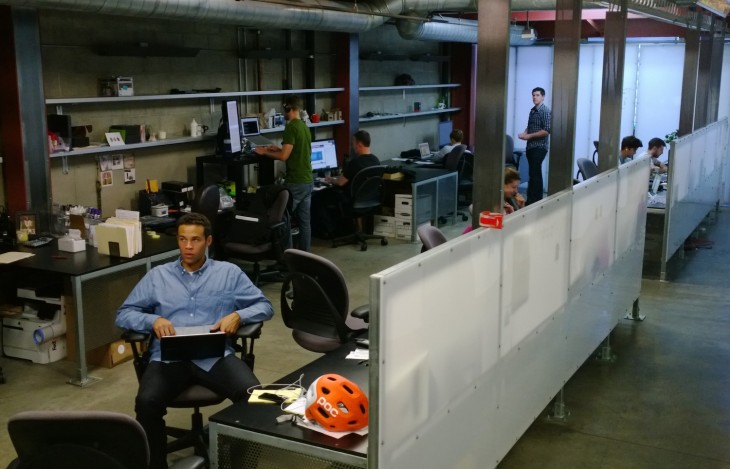

science inc 730x469 The Scientific Method: Tech studio Science Inc.s plan to build startups with repeatable results


“As one company discovers that they found gold, then everyone immediately does it,” Pham noted.


If keeping portfolio companies largely under one roof sounds complicated, that’s because it is.


“It’s always messy. We’re fixers,” Jones said. “There’s no startup we’ve ever looked at where under the covers it wasn’t just about to fly off the rails. It’s the same with every big deal.”


“Running our own companies as individuals was hard, but this is a different level,” Pham said. “We’re always just switching, trying to decide whether the decisions we’re making can benefit that company and ancillary benefit everyone else.”


Jones said that a common thread among the companies Science builds are that they’re all “tied to needs that we see in the market, personally feel, or that the founders feel.” Dog Vacay founder Aaron Hirschhorn, for example, loves dogs more than anyone else that Jones has ever met.


“Great companies are built by people that feel very personally connected to the problems they’re trying to solve,” Jones said.


Pham also emphasized that the practicality of the studio’s startups arises because the team is, from the start, looking at how to make money and generate revenue.


The two co-founders also said that they’re staying away from projects related to sectors they’ve worked with in the past. Jones, who formerly served as the CEO of MySpace, says Science isn’t planning on jumping back into social, and Pham, who worked on Photobucket and (briefly) Color, has sworn off doing any more photo startups.


Science believes that, by taking advantage of its infrastructure, startups can get up and running with half the amount of capital that most startups would need.


“We’re really efficient at deploying capital,” Pham said, citing one example where the firm brought a company in-house and cut its core expenses by half.


The caveat, though, is that Science’s infrastructure, which includes a lawyer, operations and finance, a five-person design team and traffic acquisition experts, is tailored for e-commerce businesses, so it wouldn’t necessarily be a good fit for a hardware startup.


Two years in, Science has honed its core operations to, well, a science. The firm has yet to have an exit, but, from the way things look, it’s only a matter of time.


Header image credit: Shutterstock / YanLev



via http://feedproxy.google.com/~r/TheNextWeb/~3/5RyGkW4ZP1Y/

Target to launch pre-paid mobile service on T-Mobile network on October 6th


Target will take on Walmart’s Straightalk brand with its own pre-paid wireless service, the company announced on Wednesday.


Dubbed Brightspot, the new service taps T-Mobile’s network and will offer unlimited talk and text with 1GB of 4G data for $50 a month. Unlimited talk and text with no data will cost $35 a month.


Just last week, the retailer launched a digital video service called Target Ticket.


Finding the ‘brightspot:’ Target Makes Pre-Paid Mobile a Priority [h/t AllThingsD]


Thumbnail image credit: Shutterstock / Lynn Watson


via http://feedproxy.google.com/~r/TheNextWeb/~3/q0hAm2_ptUs/

Hand gesture interface startup Flutter says that it has been acquired by Google


Flutter, the company focused on developing a hand gesture interface, says that it has been acquired by Google. Company CEO Naveet Dalal says that the team will be continuing its research at the search engine company.


If you’re not familiar with the Flutter brand, you’re probably aware of its service — it has a popular iOS application and describes itself as “Kinect for OS X” whereby it uses hand gestures to detect movement using the built-in webcam in devices to help control music and movies.


Granted that the technology is predominantly for Apple software, could we be seeing Google adding Flutter’s capabilities to its native apps or perhaps adapting it for Android? If so, perhaps leveraging it for the company’s wearable devices such as Google Glass could be in the realm of possibilities.


We’ve reached out to Google for comment and will update this if we hear back.


Here’s the acquisition announcement:


When we started three years ago, our dream to build a ubiquitous and power-efficient gesture recognition technology was considered by many as just “a dream”, not a real possibility. Since then, we have strived to build the best machine vision algorithms and a delightful user experience.


Even after we launched our first app, we didn’t stop our research; your enthusiasm and support pushed us to continue to do better. We’re inspired everyday when we hear, for example, that Flutter makes you feel like a superhero — because any sufficiently advanced technology should be indistinguishable from magic, right?


Today, we are thrilled to announce that we will be continuing our research at Google. We share Google’s passion for 10x thinking, and we’re excited to add their rocket fuel to our journey.


We’d like to extend a special thank you to all of our users; your feedback and evangelism inspire us every day. Flutter users will be able to continue to use the app, and stay tuned for future updates.


More to follow. Please refresh for updates.


via http://feedproxy.google.com/~r/TheNextWeb/~3/g_0MXC1js5Y/

4chan creator Chris Poole turned down a $50,000 acquisition offer from a Japanese toy company in 2005


4chan, one of the Web’s most trafficked imageboards, isn’t a site that you would think would get many acquisition offers. After all, even advertisers make a point to avoid it like the plague. Yet its founder, Chris Poole (also known as moot), today revealed that he received a $50,000 offer for the site from a Japanese toy company back in 2005.


Poole was 17 at the time. His rejection letter, which wasn’t sent immediately, read as follows:


Sorry for the delay. As crazy as it may seem, even an offer of that magnitude would not change my mind. The amount of time and money I and others have invested in 4chan makes it very hard to put a price on, and, not only that, but the site continues to grow in popularity immensely each day, month, etc.


For those who don’t know, 4chan is a site that is regularly linked to Internet subcultures and activism thanks to contributions such as lolcats, rickrolling, and Anonymous. Yesterday it celebrated its 10-year anniversary.


Here’s the real kicker though. Poole says the unnamed Japanese toy company no longer exists. Meanwhile, 4chan has not only outlived it, but the site’s readership is on a tear year after year.


Unsurprisingly, Poole doesn’t regret his decision:


I could not be more thankful that I made the right decision. While 4chan hasn’t made me rich, it has become my life’s work and provided me with countless friendships and a decade of entertainment. And that’s something you can’t put a price on.


What’s more important than money? Doing what you love and loving what you do.


See also – 4Chan rigs “Taylor Swift Sing on Your Campus” contest which could see her performing at a DEAF school and 4chan founder’s iPad app, DrawQuest, gets a major update with explore features and Web profiles


Top Image Credit: Thinkstock


via http://feedproxy.google.com/~r/TheNextWeb/~3/OgK2--nZ1XE/

Google starts signing up first Fiber customers in Provo, will open registration to all in January


Google today started signing up Provo residents for Google Fiber, starting with just “several thousand” that are residential customers of the local Veracity Networks. Sign-ups for the rest of Provo residents is now slated to open in January.


The reason Veracity customers are getting special treatment is simple: they’re already hooked up to Google’s newly-upgraded fiber system. This is because they were previously connected to the former iProvo network, so all they’re essentially doing is switching providers. Other Provo residents and local small businesses will have to wait till 2014; all they can do right now is sign-up to be notified when Fiber arrives in their area.


In April, Google announced it wanted Provo to become its third Fiber city. A week later, the company received Provo city council approval to buy the city’s iProvo fiber network and roll out Google Fiber.


Google notes that because it acquired iProvo, the city’s sign-up process is different (and faster) than in Kansas City and Austin. Since Google doesn’t have to install thousands of miles of new fiber-optic cables, it can save on many months of planning, engineering, as well as construction and just upgrade the network to make it faster.


In August, Google revealed three Fiber plans for the city, each of which requires the customer to pay a $30 construction. Here’s what Provo residents have to choose from:


  • Free Internet. Get today’s basic broadband speeds (up to 5 Mbps download, 1 Mbps upload) for free for at least the next seven years.

  • Gigabit Internet. Connect to the web at speeds up to 100 times faster than basic broadband (up to 1 Gbps download and upload) for $70/month.

  • Gigabit Internet + TV. Get 100 times faster Internet plus hundreds of HD channels. Record up to 8 shows at once and store up to 500 hours of HD content on your Storage Box for $120/month.


In order to get early access to Google Fiber, Google says residential Veracity customers should sign up before October 31. Those who live in apartment buildings or condos are being asked to tell their landlord they want Google Fiber and ask him or her to fill out this form. Everyone else, we think it’s time to seriously consider moving to Kansas, Austin, or Provo.


Top Image Credit: Spike Mafford


via http://feedproxy.google.com/~r/TheNextWeb/~3/NeL87TC7Sm4/