Wednesday, October 2, 2013

Intelligent personal assistant app Cue, formerly known as Greplin, shuts down


Cue, the intelligent personal assistant app that began its life as Greplin, has announced on its homepage that it has shut down. All of the app’s data and your personal information has not be stored or transferred; Cue says it has already been permanently deleted in accordance with the company’s privacy policy.


Premium users who registered through the website will be getting a prorated refund while Premium users who registered though the iPhone app can request one through iTunes. Cue gave an apology but the announcement seems to have come completely out of the blue: there was no warning, no shut down date, and no explantion beyond “the Cue service is no longer available.”


Before the intelligent personal assistant app, there was Greplin, which the company described as a “personal search engine that allows you to search all your online data in one easy place.” It let you sift through emails, tweets, and Facebook status updates from the Greplin site or the Greplin app for iOS.


In June 2012, the company rebranded as Cue, also available as both a website and iOS app. Cue pulled information from all your online accounts to present an overview of your upcoming day, in addition to the social search function provided by Greplin.


Here’s the announcement, which we’re including in full as it’s not clear how long the website will be up for:


We appreciate all of the support from you, our users, as Cue has grown over the last few years. However, the Cue service is no longer available.


Cue Premium users who registered through the website will receive a prorated refund. Cue Premium users registered though the iPhone App can request a refund through iTunes. In accordance with our privacy policy, your data and personal information will not be stored or transferred; it has been permanently deleted.


We apologize for any inconvenience this might cause you. It’s been an incredible journey that wouldn’t have been possible without your loyal support.


Our sincerest thanks,

- The Cue Team


Cue was founded by Daniel Gross and Robby Walker. Their curt message doesn’t explain where they’ll be heading next, but they’re definitely worth watching out for.


See also – Greplin Founder Daniel Gross on his amazing story behind building the company [Interview]


Top Image Credit: Alan Bridges


via http://feedproxy.google.com/~r/TheNextWeb/~3/NOnIVcCaLqs/

Yahoo reveals a new vulnerability reporting policy with rewards of up to $15,000


Yahoo revealed today that it will dole out rewards of up to $15,000 (and starting from $150) to individuals and firms that inform the company of bugs and vulnerabilities classified as new, unique and/or high-risk issues, as part of an updated vulnerability reporting policy.


This is a huge change from what Yahoo has been giving to researchers who have discovered bugs and reported them to the company: a t-shirt. Just a few days ago, Graham Cluley reported that researchers at High-Tech Bridge were rewarded with a $12.50 voucher to buy a corporate t-shirt.


Although the finalized policy will only kick in by October 31, the company is implementing the benefits retroactively back to July 1, 2013.


As it scrambles to brush up its image, Yahoo Paranoids director Ramses Martinez says in a blog post: “If you submitted something to us and we responded with an acknowledgement (and probably a t-shirt) after July 1st, we will reconnect with you about this new program. This includes, of course, a check for the researchers at High-Tech Bridge who didn’t like my t-shirt.”


Martinez adds that the company is improving its reporting process for vulnerabilities, with a new site that will make it easier to inform Yahoo of issues, which will in turn help to improve its overall speed and quality. He says that people who report issues that get validated by Yahoo’s team will be contacted directly in no more than 14 days after submission.


Headline image via Justin Sullivan/Getty Images


via http://feedproxy.google.com/~r/TheNextWeb/~3/AgpOMzsQFCU/

The Scientific Method: Tech studio Science Inc.’s plan to build startups with repeatable results


LA-based technology studio Science Inc. recently moved to a new office in Santa Monica, so we stopped by to chat with co-founders Mike Jones and Peter Pham about how the operation is going.


In just two years, Science has built up a significant portfolio of rapidly growing companies like Dollar Shave Club and Dog Vacay. However, the studio’s strategy has changed since it first began.


“We’ve evolved a lot. We originally thought we were going to spin everything out,” Jones said.


But, as the startups Science built became profitable, the team realized that it was better off just keeping them in-house. The organization grew into a central hub of highly-specialized experts that could quickly turn ideas into businesses.


“The more we invested in Science’s core infrastructure, the better our entire portfolio got.”


Science has three main approaches: it builds its own companies, takes small positions in companies that it can advise and help grow, and it acquires startups to bring them in-house.


According to Jones, the studio has benefitted from keeping a narrow focus on consumer products in three specific categories: online brands, shared economy marketplaces and infrastructure-oriented ad technologies and platforms.


Science got its start with a $10 million round in 2011. Earlier this year, it took on $30 million from Hearst Ventures. In addition to Science’s own fund, Pham noted that the studio’s portfolio companies have raised almost $70 million from outside investors.


The firm’s companies have had their share of struggles, too. Kids clothing subscription box startup Wittlebee had some fundraising trouble earlier this year that led CEO Sean Percival to step down.


Jones and Pham don’t describe their operation as an incubator, venture firm or an accelerator, calling it a technology studio instead.


“The word hands-on has a whole new meaning here. We’re highly involved, for better or for worse,” Jones said.


“We’re a company that builds companies,” Pham explained.


Given its name, I was curious whether Science is ready to produce repeatable successes. Jones and Pham admitted that it’s still too early to tell, but they were optimistic about the collective experience and knowledge of the team.


“Whether we can have replicable results, I don’t know. We’ve got a lot of knowledge stepping into deals so there is some pattern recognition for what to expect,” Jones said.


Pham added: “Every month we’re learning more, every month we’re building more. We’ve built a lot of infrastructure that we didn’t have a year and a half ago.”


“Science is very much a platform-oriented business,” Jones said. “If you think about these capabilities, there’s a lot that can grow on top of it. If we keep taking bets, investing the knowledge…I think we can get pretty big.”


Jones noted that the venture investments Science’s startups have attracted are validating the studio’s efforts.


“There’s no way we would have thought that we would have had $110 million in venture behind the things we’re working on,” Jones said.


As the Science family grows, new additions to the portfolio have the potential to instantly add value across a number of businesses. Pham pointed to Science’s recent investment in interactive video startup Fuisz as an example.


“We can leverage that against everything we’re building at Science,” Pham said. “It can also apply to everything we’re doing instantly. We can immediately test things same day.”


Same-day testing is just one of the benefits that Science gains from keeping most of the portfolio in the same 16,000-square-foot space.


science inc 730x469 The Scientific Method: Tech studio Science Inc.s plan to build startups with repeatable results


“As one company discovers that they found gold, then everyone immediately does it,” Pham noted.


If keeping portfolio companies largely under one roof sounds complicated, that’s because it is.


“It’s always messy. We’re fixers,” Jones said. “There’s no startup we’ve ever looked at where under the covers it wasn’t just about to fly off the rails. It’s the same with every big deal.”


“Running our own companies as individuals was hard, but this is a different level,” Pham said. “We’re always just switching, trying to decide whether the decisions we’re making can benefit that company and ancillary benefit everyone else.”


Jones said that a common thread among the companies Science builds are that they’re all “tied to needs that we see in the market, personally feel, or that the founders feel.” Dog Vacay founder Aaron Hirschhorn, for example, loves dogs more than anyone else that Jones has ever met.


“Great companies are built by people that feel very personally connected to the problems they’re trying to solve,” Jones said.


Pham also emphasized that the practicality of the studio’s startups arises because the team is, from the start, looking at how to make money and generate revenue.


The two co-founders also said that they’re staying away from projects related to sectors they’ve worked with in the past. Jones, who formerly served as the CEO of MySpace, says Science isn’t planning on jumping back into social, and Pham, who worked on Photobucket and (briefly) Color, has sworn off doing any more photo startups.


Science believes that, by taking advantage of its infrastructure, startups can get up and running with half the amount of capital that most startups would need.


“We’re really efficient at deploying capital,” Pham said, citing one example where the firm brought a company in-house and cut its core expenses by half.


The caveat, though, is that Science’s infrastructure, which includes a lawyer, operations and finance, a five-person design team and traffic acquisition experts, is tailored for e-commerce businesses, so it wouldn’t necessarily be a good fit for a hardware startup.


Two years in, Science has honed its core operations to, well, a science. The firm has yet to have an exit, but, from the way things look, it’s only a matter of time.


Header image credit: Shutterstock / YanLev



via http://feedproxy.google.com/~r/TheNextWeb/~3/5RyGkW4ZP1Y/

Target to launch pre-paid mobile service on T-Mobile network on October 6th


Target will take on Walmart’s Straightalk brand with its own pre-paid wireless service, the company announced on Wednesday.


Dubbed Brightspot, the new service taps T-Mobile’s network and will offer unlimited talk and text with 1GB of 4G data for $50 a month. Unlimited talk and text with no data will cost $35 a month.


Just last week, the retailer launched a digital video service called Target Ticket.


Finding the ‘brightspot:’ Target Makes Pre-Paid Mobile a Priority [h/t AllThingsD]


Thumbnail image credit: Shutterstock / Lynn Watson


via http://feedproxy.google.com/~r/TheNextWeb/~3/q0hAm2_ptUs/

Hand gesture interface startup Flutter says that it has been acquired by Google


Flutter, the company focused on developing a hand gesture interface, says that it has been acquired by Google. Company CEO Naveet Dalal says that the team will be continuing its research at the search engine company.


If you’re not familiar with the Flutter brand, you’re probably aware of its service — it has a popular iOS application and describes itself as “Kinect for OS X” whereby it uses hand gestures to detect movement using the built-in webcam in devices to help control music and movies.


Granted that the technology is predominantly for Apple software, could we be seeing Google adding Flutter’s capabilities to its native apps or perhaps adapting it for Android? If so, perhaps leveraging it for the company’s wearable devices such as Google Glass could be in the realm of possibilities.


We’ve reached out to Google for comment and will update this if we hear back.


Here’s the acquisition announcement:


When we started three years ago, our dream to build a ubiquitous and power-efficient gesture recognition technology was considered by many as just “a dream”, not a real possibility. Since then, we have strived to build the best machine vision algorithms and a delightful user experience.


Even after we launched our first app, we didn’t stop our research; your enthusiasm and support pushed us to continue to do better. We’re inspired everyday when we hear, for example, that Flutter makes you feel like a superhero — because any sufficiently advanced technology should be indistinguishable from magic, right?


Today, we are thrilled to announce that we will be continuing our research at Google. We share Google’s passion for 10x thinking, and we’re excited to add their rocket fuel to our journey.


We’d like to extend a special thank you to all of our users; your feedback and evangelism inspire us every day. Flutter users will be able to continue to use the app, and stay tuned for future updates.


More to follow. Please refresh for updates.


via http://feedproxy.google.com/~r/TheNextWeb/~3/g_0MXC1js5Y/

4chan creator Chris Poole turned down a $50,000 acquisition offer from a Japanese toy company in 2005


4chan, one of the Web’s most trafficked imageboards, isn’t a site that you would think would get many acquisition offers. After all, even advertisers make a point to avoid it like the plague. Yet its founder, Chris Poole (also known as moot), today revealed that he received a $50,000 offer for the site from a Japanese toy company back in 2005.


Poole was 17 at the time. His rejection letter, which wasn’t sent immediately, read as follows:


Sorry for the delay. As crazy as it may seem, even an offer of that magnitude would not change my mind. The amount of time and money I and others have invested in 4chan makes it very hard to put a price on, and, not only that, but the site continues to grow in popularity immensely each day, month, etc.


For those who don’t know, 4chan is a site that is regularly linked to Internet subcultures and activism thanks to contributions such as lolcats, rickrolling, and Anonymous. Yesterday it celebrated its 10-year anniversary.


Here’s the real kicker though. Poole says the unnamed Japanese toy company no longer exists. Meanwhile, 4chan has not only outlived it, but the site’s readership is on a tear year after year.


Unsurprisingly, Poole doesn’t regret his decision:


I could not be more thankful that I made the right decision. While 4chan hasn’t made me rich, it has become my life’s work and provided me with countless friendships and a decade of entertainment. And that’s something you can’t put a price on.


What’s more important than money? Doing what you love and loving what you do.


See also – 4Chan rigs “Taylor Swift Sing on Your Campus” contest which could see her performing at a DEAF school and 4chan founder’s iPad app, DrawQuest, gets a major update with explore features and Web profiles


Top Image Credit: Thinkstock


via http://feedproxy.google.com/~r/TheNextWeb/~3/OgK2--nZ1XE/

Google starts signing up first Fiber customers in Provo, will open registration to all in January


Google today started signing up Provo residents for Google Fiber, starting with just “several thousand” that are residential customers of the local Veracity Networks. Sign-ups for the rest of Provo residents is now slated to open in January.


The reason Veracity customers are getting special treatment is simple: they’re already hooked up to Google’s newly-upgraded fiber system. This is because they were previously connected to the former iProvo network, so all they’re essentially doing is switching providers. Other Provo residents and local small businesses will have to wait till 2014; all they can do right now is sign-up to be notified when Fiber arrives in their area.


In April, Google announced it wanted Provo to become its third Fiber city. A week later, the company received Provo city council approval to buy the city’s iProvo fiber network and roll out Google Fiber.


Google notes that because it acquired iProvo, the city’s sign-up process is different (and faster) than in Kansas City and Austin. Since Google doesn’t have to install thousands of miles of new fiber-optic cables, it can save on many months of planning, engineering, as well as construction and just upgrade the network to make it faster.


In August, Google revealed three Fiber plans for the city, each of which requires the customer to pay a $30 construction. Here’s what Provo residents have to choose from:


  • Free Internet. Get today’s basic broadband speeds (up to 5 Mbps download, 1 Mbps upload) for free for at least the next seven years.

  • Gigabit Internet. Connect to the web at speeds up to 100 times faster than basic broadband (up to 1 Gbps download and upload) for $70/month.

  • Gigabit Internet + TV. Get 100 times faster Internet plus hundreds of HD channels. Record up to 8 shows at once and store up to 500 hours of HD content on your Storage Box for $120/month.


In order to get early access to Google Fiber, Google says residential Veracity customers should sign up before October 31. Those who live in apartment buildings or condos are being asked to tell their landlord they want Google Fiber and ask him or her to fill out this form. Everyone else, we think it’s time to seriously consider moving to Kansas, Austin, or Provo.


Top Image Credit: Spike Mafford


via http://feedproxy.google.com/~r/TheNextWeb/~3/NeL87TC7Sm4/

LinkedIn redesigns its apps for iOS 7, adds endorsements and beginner’s guide to mobile site


LinkedIn today announced a slew of updates for those that access the professional social network from their phone or tablet. The improvements include an iOS 7 refresh and new features for the mobile site.


First and foremost, LinkedIn and Pulse have been refreshed for iOS 7 with “flatter, cleaner and more modern designs” as well as “sharp edges and soft colors.” You can download the new versions from Apple’s App Store: LinkedIn and Pulse.


Next up, LinkedIn’s mobile site now lets you endorse connections, as well as accept endorsements from your connections and add skills to your profile. New members visiting LinkedIn from a mobile device will now be greeted with a step-by-step guide that explains how to build your network, join groups, and follow channels for “professional news.”


LinkedIn promises that more mobile updates are on the way, but in the meantime you can check out all these additions in the following slideshow:


Coincidentally, BlackBerry today also updated its LinkedIn app for BlackBerry 10 (you can download the new app now directly from BlackBerry World). Here’s what’s new in version 10.1.5:


  • Improved search for People, Jobs, and Companies – Users are now able to search for a keyword and find results in the People, Jobs or Company tabs.

  • New interface for sharing articles – LinkedIn users have an improved interface that lets them easily share their favorite articles from LinkedIn to all of their connections.

  • New simpler design – New updates provides a cleaner, richer experience for users.


LinkedIn has been pushing hard to keep its mobile apps fresh. Although updates tend to take a while to arrive, their frequency has certainly increased as of late.


See also – LinkedIn now lets users apply for jobs from its mobile apps and LinkedIn is 10 years old today: Here’s the story of how it changed the way we work


Top Image Credit: mariosundar / Flickr


via http://feedproxy.google.com/~r/TheNextWeb/~3/rbflBjZc_Is/

Microsoft adds Pinterest boards to Bing Image Search as part of broader ‘image collections’ feature


Microsoft today expanded its partnership with Pinterest that will see the social network’s related boards show up in Bing’s search results. These are called Image collections, which brings together curated collections of images from around the web, and will show up alongside regular search results when you search for an image on Bing.


The two companies first partnered back in April, adding a new “Pin to Pinterest” option to Bing. As its name implies, the feature lets users pin image results directly from the search engine to their boards.


Now the deal has become a two-way street: instead of just bringing Bing images to Pinterest, Bing users can now find Pinterest boards in the search engine. Let’s take a closer look, shall we?


Here’s what happens on Bing Image Search when your query is “Halloween decorating ideas“:


Halloween 647E95D9 1 730x632 Microsoft adds Pinterest boards to Bing Image Search as part of broader image collections feature


Here is “updo hairstyles“:


Updos 1B0C411E 730x664 Microsoft adds Pinterest boards to Bing Image Search as part of broader image collections feature


You can see the difference between the “normal” results on the left and the image collections on the right. The former features the results of Bing’s computer vision and computational horsepower sifting through billions of images while the latter shows you creative collections by people who are passionate about decorating their house or getting their hair done.


In short, Microsoft wants to bring you the best of both worlds (algorithms plus the taste and judgment of real people). In fact, the company admitted image search sucks when it’s just automated: “But lately, we’ve noticed that the most interesting pictures on the web are being collected by people, not computers.”


What makes this feature interesting is that it’s named “image collections” and not just “Pinterest boards.” This leads us to believe that Microsoft plans to add more partners sometime soon, and the company does indeed hint at such an expansion: “This is only the beginning of our exploration of ways to showcase social communities within Bing image search, so stay tuned for more in the weeks and months ahead.”


What’s next? Bing and Instagram? It has a ring to it, and Microsoft already has a close relationship with Facebook, but we’re not sure it’s the best idea for either party.


Top Image credit: Alessandra Favetto


via http://feedproxy.google.com/~r/TheNextWeb/~3/uZGNVv9S0DU/

Google launches Google Partners, a program to give small businesses Web resources, support, and training


Google today announced the launch of Google Partners, a new program designed to help small businesses grow on the Web by giving them resources, support, and training. As the name implies, the company will be achieving this goal by connecting small business to its trusted partners.


If you’re wondering why Google hasn’t already done this before, that’s a fair question. The fact is the company has been toying with such initiatives for a while: this is merely an amalgamation of all of them.


Google Partners brings all of the company’s existing programs together under this new platform. This means small businesses can find “all” of the company’s resources under one roof, including certification via free Google exams, access to Google experts and agency peers through the community, as well as sales and marketing toolkits.


Google Partners has three objectives, all aimed at helping customers:


  • Connect more closely with Google. With access to special events, training and the latest research and product updates, Partners stay ahead of the curve by working directly with Google.

  • Demonstrate credibility. The new Google Partner badge recognizes companies that excel with Google’s products. Their businesses are healthy, their customers are happy, and they use Google best practices.

  • Grow your business. Partners who’ve earned the badge are listed on Google Partner Search and get a direct connection to potential clients.


In other words, Google wants to help build the next few Googles. If all goes well, it can partner with them and maybe even acquire them.


Here’s the company’s pitch: “Every business should have the help it needs to succeed on the web. Every day, agencies and web professionals work with businesses big and small to bring us closer to that reality.” Google of course wants to build its own reality.


More to follow.


via http://feedproxy.google.com/~r/TheNextWeb/~3/JgarXKr8_FM/

Lucid Software brings the power of desktop publishing to the Web with Lucidpress, now in beta


Cloud-based productivity app provider Lucid Software opened up the beta release of its web-based drag-and-drop publishing app. With Lucidpress, users will be able to develop professional-looking content for either print or the Web. It’s essentially a competitor to Microsoft Publisher.


Believing that design apps are either too complex, expensive, or just aren’t serving the needs of its users, Lucid Software set out to create a new tool where anyone can create a publication from anywhere on any device with the “robust performance of a desktop application”.


Image Management Hero 730x447 Lucid Software brings the power of desktop publishing to the Web with Lucidpress, now in beta


Lucidpress enables users to create any type of document and includes integrations with Google Drive, Dropbox, Flickr, YouTube, and Facebook.


If you look closely at Lucidpress, it’s almost reminiscent of Google Docs, except that Google doesn’t offer a really robust way of creating publications. With Lucidpress, you can collaborate in real-time with your colleagues just like you could on Google Docs. The interface is simple enough to use thanks to drag-and-drop functionality.


Collaboration Hero 2 730x413 Lucid Software brings the power of desktop publishing to the Web with Lucidpress, now in beta


Lucidpress also works on mobile devices as well and users can view their publications through the browser.


Company CEO Karl Sun said in a statement:


Where desktop software lags behind the new realities of an evolved market, we see a clear future with web-based applications. With Lucidpress, our goal is to make it easy for anyone to create stunning content like a design pro with all the added functionality made possible in the cloud.


Anyone can sign up to try out Lucidpress during its beta trial and it’s free to use. The company will reveal its pricing options once the service has opened to the public.


Lucidpress


Photo credit: Shutterstock


via http://feedproxy.google.com/~r/TheNextWeb/~3/UKxNVZuK-B8/

Download driver Acer | mangga sumping di kota hujan


Aspire 5600U untuk win 7 64 Bit


AHCI Download


AMT Download


Accessory Download


Audio Download


Chipset Download


FIR Download


Lan Download


Others Download


Others Download


TV Tuner Download


VGA Driver Download


Wireless LAN Driver Download


. Buat penanda ke


.


via download driver - Penelusuran Blog Google

Tuesday, October 1, 2013

Dropbox gains certification for mobile security service Samsung Knox, offers 90-day trial to business users


Dropbox today announced it has been certified for Samsung Knox, a mobile security service that helps protect devices in the event that they become corrupted, stolen, or need to be replaced. In other words, Dropbox is now available on the Knox Apps store, which the company says will give employees the access they want while maintaining “crucial IT control.”


At the same time, Dropbox wants to make it as easy as possible to get Samsung users on board. As such, registered Knox users can try Dropbox for Business free for 90 days over here.


See also – Dropbox can now automatically save your screenshots when you take them, and import photos from iPhoto and Dropbox’s new Modern UI Windows 8 app finally arrives in the Windows Store


Top Image Credit: Thinkstock


via http://feedproxy.google.com/~r/TheNextWeb/~3/Q0FktfA1gRw/

Google rolls out Chrome 30 with easier searching by image and new touch-based gestures on Android


Google will be pushing out a new version of its Chrome for Android and desktop app over the next few days, which adds a new search by image option and a number of extra touch-based gestures to help smartphone and tablet users navigate the Web.


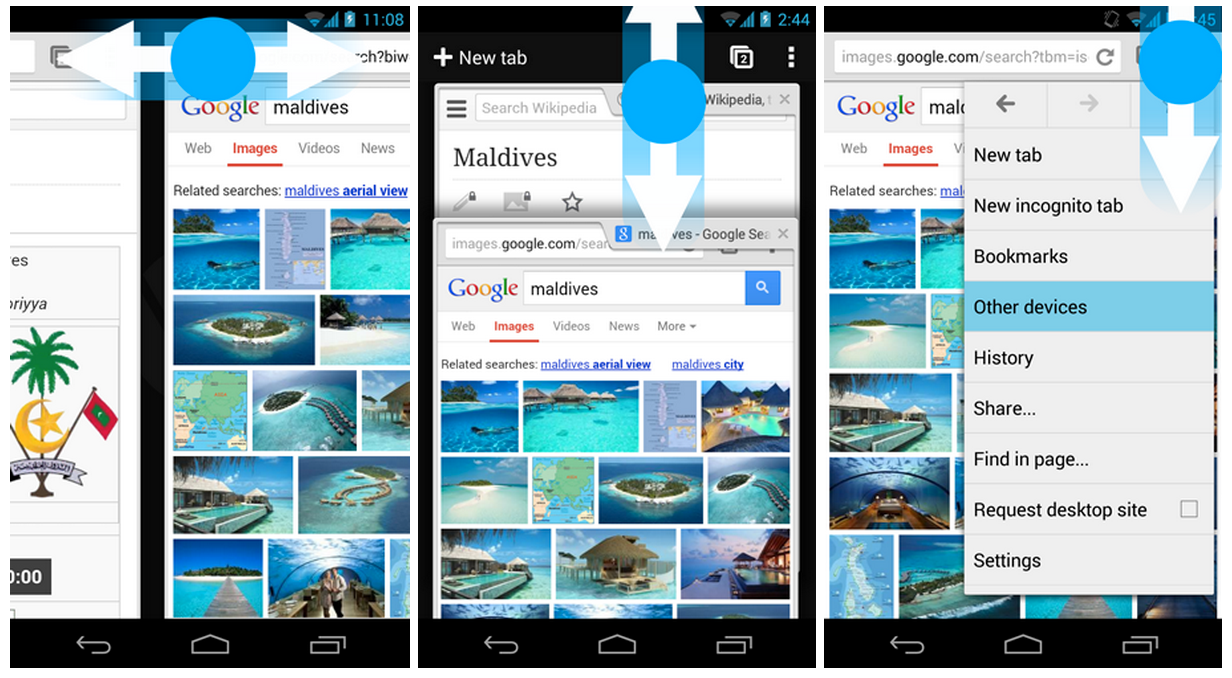
As detailed during the beta release, users will now be able to swipe horizontally across the top toolbar to quickly switch between open tabs, or drag down to enter the tab switcher view.


The latter sounds particularly useful, as it gives Android users the ability to review all of their active tabs simultaneously and quickly jump to whatever webpage they need next.


Screen Shot 2013 08 21 at 11.20.42 PM Google rolls out Chrome 30 with easier searching by image and new touch based gestures on Android


The update will also give Chrome users the ability to drag down from the menu to open it, before scanning down and selecting the relevant option without lifting their finger from the screen.


In addition, Google is also rolling out the ability to search for an image within the desktop version of Chrome just by right-clicking or long-pressing.


Google says the new versions of Chrome will be available “starting this week”, so don’t worry if it isn’t there just yet. It’s coming.


image search 1 Google rolls out Chrome 30 with easier searching by image and new touch based gestures on Android


Image Credit: KIMIHIRO HOSHINO/AFP/GettyImages


via http://feedproxy.google.com/~r/TheNextWeb/~3/bTtj5z_BpsM/

SOL Republic targets serious audiophiles with its $250 Master Tracks XC over-ear headphones


SOL Republic has launched its first “professional-caliber” pair of over-ear headphones today called the Master Tracks XC.


British DJ and producer Calvin Harris has put his name to the sytlish cans, which are meant to deliver prefessional-grade audio through the firm’s new XC Sound Engine. The result should be deep, low-end bass complimented by a stronger mid-range and extended high notes.


The headphones will be launching worldwide in October for $249.99. Keep your eyes locked on The Next Web – we’ll have an in-depth review of the Master Tracks XC up in the next few days.


Master Tracks XC


via http://feedproxy.google.com/~r/TheNextWeb/~3/SkC0Rv29ZcI/

NVIDIA GeForce Video Card Drivers v327.23 Now Available


NVIDIA LogoNVIDIA has released GeForce drivers version 327.23. This release increases performance in several games, adds a few SLI profiles, and adds support for some additional 4K displays.


This is the final, WHQL version of these drivers and replaces the previously available v320.49 WHQL drivers. You should install v327.23 if you have a supported NVIDIA GPU running any previous driver release.


Important: This NVIDIA driver was previously available as several different beta versions (v236.80, v326.41, and v326.19). If you installed any of those beta versions of this driver, please update to v327.23 as soon as possible. It's almost always a better idea to have the WHQL certified version of a driver installed.


Here are some of the new features, changes, and fixes available in v327.23 over previous releases:


  • Improves the performance of several games across a number of NVIDIA GPUs.

  • Adds SLI profiles for Splinter Cell: Blacklist and Batman: Arkham Origins.

  • NVIDIA PhysX is at v9.13.0725 and HD Audio is at v1.3.26.4 in this release.


For complete information on v327.23, see NVIDIA's Version 327.23 Release Notes for Windows 8.1/8/7/Vista here (desktop) and here (notebook), or the Version 327.23 Release Notes for Windows XP here. All links are to PDF files.


Download Links:


Most NVIDIA GPUs are fully supported with the v320.49 driver in most current versions of Windows, like Windows 8 (including Windows 8.1), Windows 7, and Windows Vista.


The following two downloads are for Desktop GPUs ONLY. These are the NVIDIA drivers you need if you have a video card with an NVIDIA ION/ION LE or GeForce GPU installed in your desktop computer.


32-bit Download [Windows 8/8.1, 7, Vista]

64-bit Download [Windows 8/8.1, 7, Vista]


These two downloads are for Notebook GPUs ONLY. These are the NVIDIA drivers you need if your laptop, netbook, notebook, or tablet is powered by an NVIDIA ION/ION LE or GeForce GPU.


32-bit Download [Windows 8/8.1, 7, Vista]

64-bit Download [Windows 8/8.1, 7, Vista]


Tip: Not sure if you should download the 32-bit or 64-bit driver? See Am I Running a 32-bit or 64-bit Version of Windows? for help. If you need even more assistance, head over to the GeForce Drivers page and click on the big green AUTO-DETCT YOUR GPU button.


Windows XP Drivers: NVIDIA supports Windows XP less and less with each new GPU and driver release. However, they do support many GPUs on Windows XP with their newest v327.23 drivers. You can download the 32-bit driver here or the 64-bit driver here. These drivers are only designed for desktop GPUs but you may have luck getting them to work on your notebook PC. If not, check with your notebook maker for better drivers or with NVIDIA for an older release.


Other downloads like nForce drivers, GeForce drivers for non-Windows operating systems, previous driver releases, and much more, can be found here.


Note: If you're using a relatively recent version of NVIDIA's GeForce drivers, just right-click on the NVIDIA icon in the system tray and choose Check for updates.... You can download and install the driver automatically from there. If you want to be prompted for beta driver updates, be sure to check the appropriate box in the Preferences tab.


Tip: If you're looking for an up-to-date resource on new drivers, see my Windows 7 Drivers and Windows 8 Drivers pages. I keep those pages updated with information and links to new drivers available from NVIDIA and other major hardware makers.


Related Topics:


Connect With Tim: Google+ | Twitter | Facebook


via download driver - Penelusuran Blog Google

Cover’s dining out app for iOS aims to eliminate time spent waiting for your check


Cover has launched out of beta with an iOS app that lets restaurant goers in New York City easily pay for their meals without having to wait for the check.


Among first world problems, waiting for the bill at a restaurant ranks near the top of the list. Cover has set out to create a win-win situation for both businesses and consumers by providing a convenient service that processes payments at below market rate.


cover 3 220x392 Covers dining out app for iOS aims to eliminate time spent waiting for your check


The startup has been beta testing the app in New York for the past year and is now ready to release it to the public with more than 2,000 restaurants signed up. Cover has plans to arrive in other cities, but it’s focusing its energy first on the active dining scene in New York in order to make sure it can repeat the results in other locations.


Once you’ve set up an account with Cover, you can go to a participating restaurant, open the app to create a table or join an existing one, and then notify your server that you’re going to pay with Cover. When you’re done with the meal, you can just walk away.


The app includes support for splitting checks and gratuity. You can specify a default tip amount so you don’t need to take your phone out during the meal, but you can also adjust the percentage if you’re having a really good (or bad) experience.


cover 1 220x392 Covers dining out app for iOS aims to eliminate time spent waiting for your check


I have yet to try paying with Cover myself, but the service has drawn comparisons to Uber because of the way it streamlines a common consumer transaction that has historically had pain points for businesses and customers alike.


Cover co-founders Andrew Cove and Mark Egerman contend that the service they’ve built is solving more than just a first-world problem. While they conceded that simply waiting for a bill could be construed as such, their approach with Cover has been to tackle a payment experience that has been broken for all players.


Between recent NYC launches from Wunwun and Cover, it’s beginning to feel like New Yorkers get all the nice things. If you happen to be in town for TNW Conference USA, you can give either app a spin. The rest of us will have to just hope they get around to expanding sooner than later.


Cover | App Store


Image credit: Shutterstock / Joe Belanger


Disclosure: This article contains an affiliate link. While we only ever write about products we think deserve to be on the pages of our site, The Next Web may earn a small commission if you click through and buy the product in question.


via http://feedproxy.google.com/~r/TheNextWeb/~3/8VEw8xtNCDs/

IE6 finally falls below 5% market share, but IE up overall as Firefox and Chrome dip


The third quarter of 2013′s browser war is now over. September saw the sixth full month of IE10 availability on Windows 7, as well as the release of Firefox 24 and one full month of Chrome 29 availability. The latest market share numbers from Net Applications show Internet Explorer was the biggest winner last month.


Between August and September, IE gained 0.19 percentage points (from 57.60 percent to 57.79 percent), Firefox slipped 0.22 percentage points (from 18.80 percent to 18.58 percent), and Chrome dipped 0.02 percentage points (from 16.00 percent to 15.98 percent). Safari meanwhile gained 0.18 percentage points to 5.77 percent and Opera slipped 0.06 percentage points to 1.47 percent.


ie september 2013 730x514 IE6 finally falls below 5% market share, but IE up overall as Firefox and Chrome dip


At 57.79 percent, Internet Explorer has hit a new high for the year. January was the first time the browser went back above the 55 percent mark, and while the next few months have shown it won’t be losing that crown anytime soon, it still has a long way to go before the 60 percent mark.


At 19.45 percent in September, IE10 has slowed its growth, although it has still managed to grab another 0.80 percent share. Meanwhile, IE9 has regained 0.43 percentage points, to 9.45 percent. Soon IE11 will be following in its predecessor’s footsteps, given that it will be available for both Windows 7 and Windows 8.


IE8 meanwhile slipped 0.26 percentage points, but it’s still the world’s most popular browser at 21.39 percent. The real tragedy here is that IE10 is mainly stealing share from IE9 on Windows 7, since Windows XP users can’t upgrade past IE8.


IE7 was down 0.17 percentage points to 1.37 percent and IE6 slipped a huge 1.22 percentage points to 4.86 percent. This means it has finally fallen below the 5 percent mark, which we weren’t expecting till sometime later this year.


firefox september 2013 730x519 IE6 finally falls below 5% market share, but IE up overall as Firefox and Chrome dip


At 18.58 percent, Firefox seems to be maintaining its new low. The last three months aside, the last time we saw the browser at 18 percent was way back in May 2008. Firefox 24 was just released, so it only managed to grab 2.17 percent share, while Firefox 23 hit 11.57 percent. All the other versions lost share: Firefox 22 fell 6.14 points, Firefox 21 lost 0.15 points, and Firefox 20 dipped 0.06 points.


chrome september 2013 730x508 IE6 finally falls below 5% market share, but IE up overall as Firefox and Chrome dip


At 15.98 percent, Chrome is close to its 21-month low in May. Chrome 29 grabbed 12.82 percentage points after being available for a full month. All other versions were down or flat: Chrome 28 lost 9.13 points, Chrome 27 slipped 0.21 points, while Chrome 26 and Chrome 25 lost a combined 0.03 points.


Net Applications uses data captured from 160 million unique visitors each month by monitoring some 40,000 websites for its clients. StatCounter is another popular service for watching market share moves; the company looks at 15 billion page views. To us, it makes more sense to keep track of users than page views.


Nevertheless, for September 2013, StatCounter listed Chrome as first with 40.80 percent market share, IE in second with 28.56 percent, Firefox in third with 18.36 percent, Safari with 8.52 percent, and Opera with 1.16 percent. The only part everyone agrees on is that Safari and Opera are not in the top three.


See also – Windows 8 now up to 8.02% market share but Windows 7 sees bigger gains for the first time


Top Image Credit: Hugo Humberto Plácido da Silva


via http://feedproxy.google.com/~r/TheNextWeb/~3/RiI9O_btG_0/

Windows 8 now up to 8.02% market share but Windows 7 sees bigger gains for the first time


With back-to-school sales now over, Windows 8 has returned to its slow but steady growth in market share. Meanwhile, Windows 7′s hold not only remains strong, but it has outgrown its successor for the first time, showing it will indeed stay the most popular operating system version for a long time.


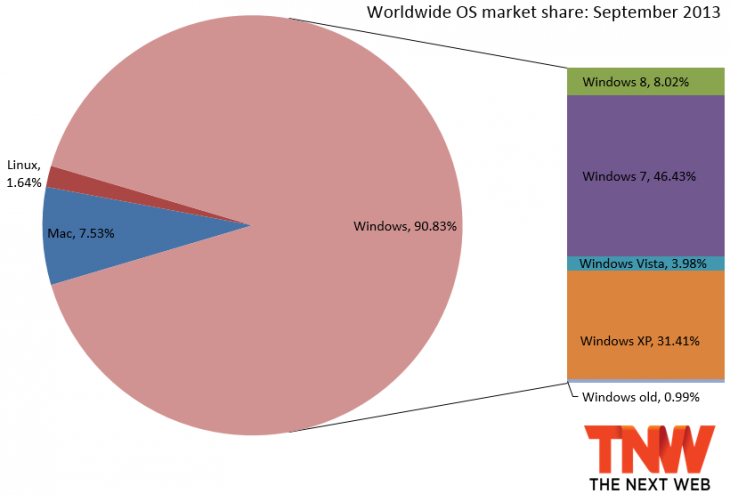
The latest market share data from Net Applications shows that September 2013 was a solid one for Windows 8, which gained 0.61 percentage points (from 7.41 percent to 8.02 percent) while Windows 7 recovered 0.80 percentage points (from 45.63 percent to 46.43 percent). This is the first time Windows 7 has gained more share than Windows 8 since the latter’s release.


os september 2013 730x494 Windows 8 now up to 8.02% market share but Windows 7 sees bigger gains for the first time


Windows 8 hasn’t been growing as quickly as some would have hoped, but recently the numbers have been all over the place. August was its biggest gain so far at 2.01 percentage points, while July (0.30 percentage points) was its smallest since its official release in October.


We attributed August’s huge jump to the price cut of both the Surface RT and Surface Pro, the RTM of Windows 8.1 and subsequent leaks, as well as corporations speeding up their upgrade paths away from Windows XP. Still, all these factors didn’t seem to be enough and we predicted Windows 8 could end up seeing a drop in share for September.


“If it doesn’t, students buying new computers will be the main reason for its continued gains,” we concluded last month. It looks like schools have managed to keep Windows 8 going steady.


In January, Windows 7 lost market share for the first time since its release, just a month after passing the 45 percent mark. It has been hovering below that mark ever since, but in August it surpassed the figure again, and now it’s past 46 percent.


The gains of both Windows 8 and Windows 7 can be attributed to a minor drop for Windows Vista, which declined 0.13 percentage points (from 4.11 percent to 3.98 percent), and a huge one for Windows XP, which dropped 2.25 percentage points (from 33.66 percent to 31.41 percent). Next month it will likely be below the 30 percent mark for the first time in years.


So far this year, Windows has lost share every month except for March and July. Between August and September, Windows lost 0.36 percentage points (from 91.19 percent to 90.83 percent). This loss was OS X’s and Linux’s gain: up 0.25 percentage points (to 7.53 percent) and 0.12 percentage points (to 1.64 percent), respectively.


Net Applications uses data captured from 160 million unique visitors each month by monitoring some 40,000 websites for its clients. StatCounter is another popular service for watching market share moves; the company looks at 15 billion page views. To us, it makes more sense to keep track of users than of page views, but if you prefer the latter, the corresponding data is available here (Windows 8 is at 7.46 percent).


See also – As Windows Phone 8 fulfilled the Windows Phone promise, so will Blue complete Windows 8


Top Image Credit: Robert Linder


via http://feedproxy.google.com/~r/TheNextWeb/~3/n6-6JorXbb8/